
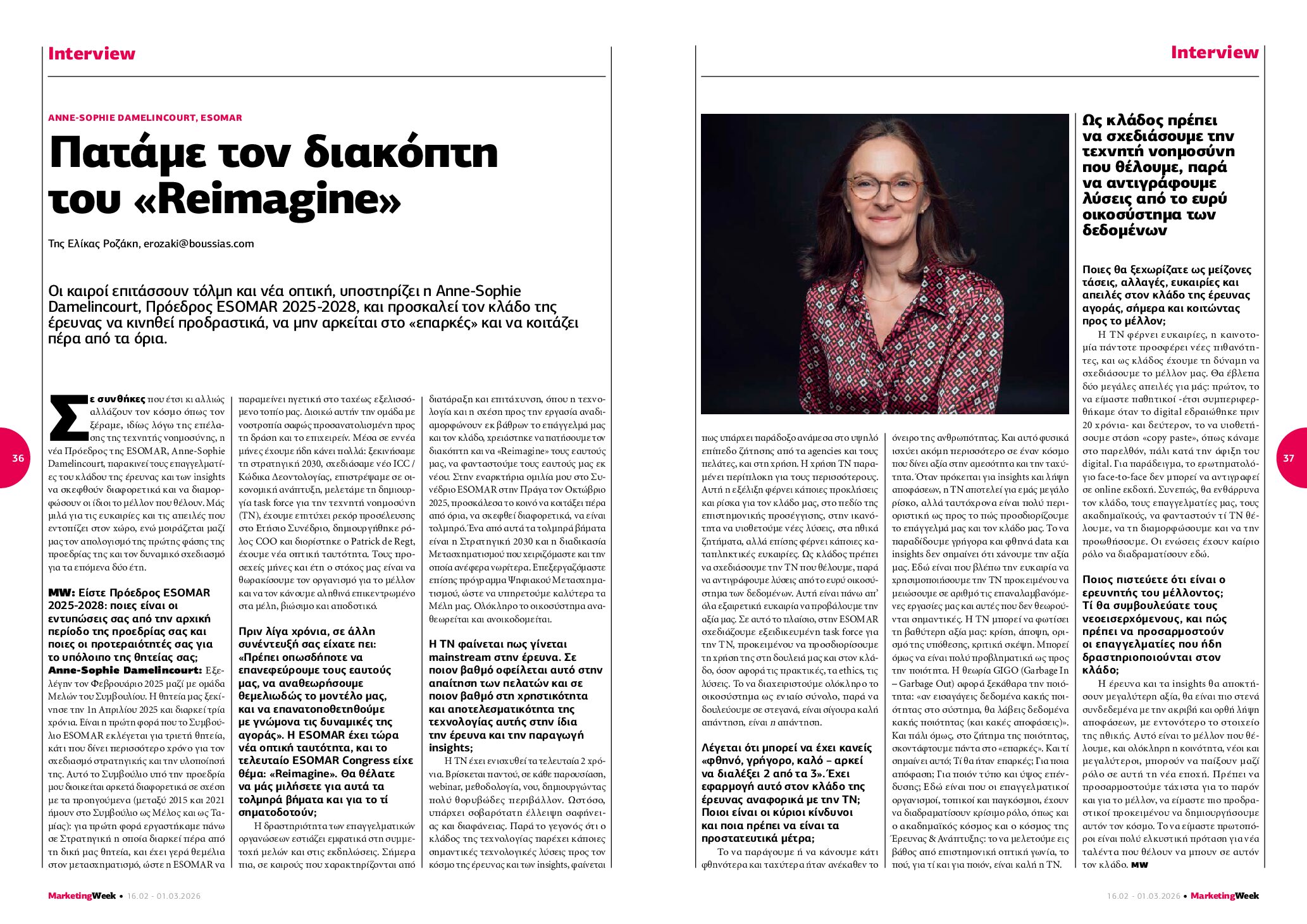
You are ESOMAR President for 2025-2028: what are your impressions from the initial period of your presidency, and what are your priorities for the remainder of your term?
I was elected in February 2025 with a team of Council Members. We started our term on April 1st 2025 for three years. It is the first time that Esomar Council is elected for a 3 year-term which gives more time to design strategy and to implement it. This Council under my presidency is lead quite differently from the previous Councils (I was on Council as a Member and as Treasurer, between 2015 and 2021): for the first time we have worked on a Strategy which goes beyond our term, with a strategy anchored into transformation, aiming Esomar to keep its leadership in our fast-evolving landscape. I am leading this team with a clear action-driven and business-oriented mindset. In 9 months we have already done a lot: we have initiated the strategy 2030, have designed a new ICC/ Code of Conduct, financial growth is back, we are working on an artificial intelligence task force, we have reached records in terms of Annual Congress attendance, we have created a COO role and hired Patrick de Regt, we have a new visual identity. In the coming months and years our objective is to future-proof the organization, and to make it truly member-centric, sustainable and efficient.
A few years ago, in a different interview, you said: “We really must reinvent ourselves, fundamentally rethink our model, and reposition ourselves in line with market dynamics”. ESOMAR now has a new visual identity, and the latest ESOMAR Congress was themed: “Reimagine”. Would you like to tell us a bit about these bold steps and what they signify?
The business of professional organisations is very focused on membership and events, with a strong dependency. In our disruptive and accelerating times, where technology and relationship to work are profoundly reshaping our profession and our industry, we had a operate a switch, and to Reimagine us. In my opening speech at Esomar Congress in Prague in October 2025, I invited the audience to look beyond boundaries, to think differently, to be bold. One of these bold steps are the Strategy 2030 and the Transformation process we are operating and which I mention above. We are also working on a Digital Transformation project to better serve our Members. The whole ecosystem and economic model are being rethought and rebuilt.
AI has apparently become mainstream in research. How much of this is driven by client demands and how much by actual usability and effectiveness of this technology in research and insights generation?
AI has come into force for 2 years. AI is everywhere, in any presentation, webinar, methodology, mind, creating a very noisy environment. However there is a profound lack of clarity and transparency. Despite some important technology solutions provided by the tech industry to the research and insight world, it seems that there is a paradox between the high level of demand from agencies and clients, and the usage. The use of AI remains complex for most. This evolution brings some challenges and risks for our industry, in terms of scientific approach, ability to adopt new solutions, ethics, but also some fantastic opportunities. As an industry we must design what AI we want rather than copy pasting solutions from the wide data ecosystem. This is above all a great opportunity to showcase our value. In this field, Esomar is working on a solid AI taskforce, broadly gathering expertise to define AI in our work and industry, in terms of practices, ethics, solutions. Embedding the whole ecosystem as a whole rather than working in silos is definitively a good answer, the answer.
It is said that “you can have cheap, fast, good; pick any two”. With regards to AI, does this saying apply to the research industry? What are the main dangers and what should be the guard-rails?
Producing or doing cheaper and faster has always been the dream of humanity. And this is of course even truer in a world which values instantaneousness and immediacy.
When it comes to insights and decision-making, AI is a big risk for us but also a very restrictive way of defining our profession and our industry. Delivering fast and cheap data and insights doesn’t mean that we lose our value. This is where I see AI as an opportunity to use AI to reduce our repetitive and non-valued tasks. AI can put light on our deepest value: judgement, opinion, definition of hypothesis, critical thinking.
It can be very problematic in terms of quality. The GIGO (Garbage In – Garbage Out) idea is explicit on quality: ‘if you put bad quality data in the system, you get bad quality data (and bad decision-making)’. Still on the quality aspect we see everywhere the ‘Good enough’ concept. What does this mean? What would good enough be? For what decision? What type and amount of investment? This is where professional organisations, local and global, have a crucial role to play, as well as the academic and Research & Development worlds, deeply studying from a scientific perspective, where and for what and who, AI is good at.
What would you identify as the major trends, shifts, opportunities and threats to the market research industry, today and going forward?
AI brings opportunities, innovation always offers new possibilities, and as an industry we have the power to design our future. I would see two big threats for us: number one is to be passive – this was our behaviour when digital came into force 20 years ago – and the second one would be that we adopt the ‘copy paste’ position, as we did in the past again with the arrival of the digital (ie: a face-to-face questionnaire can’t be pasted for an online version). So, I would encourage the industry, our professionals, academics to imagine what AI we want, to shape it and to promote it. Associations have a key role to play here.
Who do you believe is the researcher of the future? What would you advise young professionals, and how should the existing pros adapt?
Research and insight will be more valued, more anchored to precise and good decision-making, more ethics. This is the future we want and the whole community, young and older can play a role in this new era together.
We need to adapt rapidly and beyond, to be more proactive to create this world. Being ahead of the curve is a very attractive proposition for young talents who want to enter this industry.
Thanks for Erika Rozaki for interviewing me.
